If you’ve ever been involved in a discussion about commercial electrical drawings, equipment schedules, bids, or an upgrade proposal, you might have come across terms such as switchgear, switchboard, and panelboard. They can sound interchangeable, especially when you’re looking at a project from an owner, facility manager, or construction perspective. However, they are quite different.
Each type of electrical distribution equipment has a different role within a commercial electrical system. The right equipment depends on the building’s electrical system, protection requirements, available space, maintenance considerations and plans, and applicable project requirements.
This guide highlights how understanding the difference between these terms can help you ask better questions, evaluate project proposals, and communicate more effectively with the electrical team.
Quick Comparison: Panelboard, Switchboard and Switchgear
| Factor | Panelboard | Switchboard | Switchgear |
| Basic Purpose | Distributes power to downstream circuits | Receives and distributes power to multiple downstream loads or panels | Provides distribution and protection where the system calls for specific functionality or performance |
| System Role | Branch-level distribution | Larger distribution point | Distribution and protection equipment tied to system requirements |
| Service/Access | Serves local circuits | Positioned for larger distribution | Configurations tied to isolation and serviceability |
| Complexity Considerations | Common, smaller-scale | More involved than a panelboard | Typically higher complexity |
| Common Project Context | Throughout commercial buildings | Central distribution areas | Where system protection or isolation needs call for it |
What Is a Panelboard?
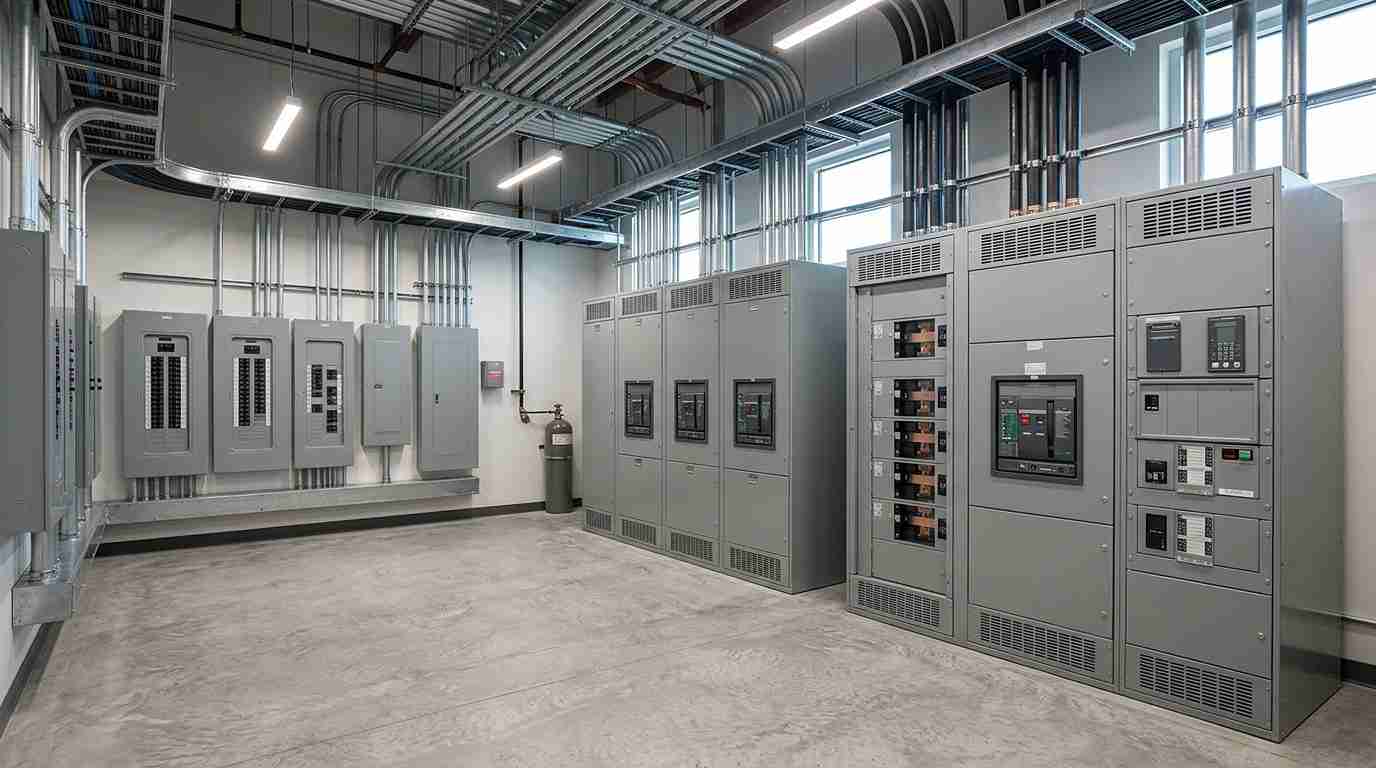
A panelboard distributes power to downstream circuits. You can find them throughout commercial buildings serving lighting, receptacles, and other branch circuits. They’re widely used and central to everyday building operations.
Panelboards contain protective devices, which is why some people assume they’re interchangeable with main distribution equipment. However, a panelboard serves branch-level distribution; it doesn’t play the same role as larger distribution gear just because it contains breakers.
Moreover, a panelboard needs to work as part of the broader distribution system. That’s why its location, the circuits it serves, the available electrical capacity, and the building’s existing infrastructure can all influence how it fits into a project.
What Is a Switchboard?
A switchboard is larger distribution equipment that may receive and distribute power to multiple downstream loads or panels. In a commercial building, it can play a higher-level role in the electrical distribution system, being placed between incoming power and downstream distribution points.
A switchboard’s footprint can affect electrical-room planning, and its accessibility can affect how the equipment is serviced. Moreover, its positioning within the distribution system can also influence how power is routed to downstream equipment.
This is where switchboard vs switchgear discussions can become confusing. The two terms describe different equipment categories and should not be treated as interchangeable labels. We’ll look at that in the next section.
What Is Switchgear?
Switchgear is distribution and protection equipment used where the system calls for particular protective functionality, isolation, serviceability, or performance. Rather than thinking of switchgear as a generic term for every electrical panel, it is more useful to consider what role the equipment needs to perform within the system.
Switchgear can be part of a commercial electrical distribution strategy where the project requires specific ways of controlling, protecting, isolating, or servicing portions of the electrical system.
However, that does not mean every large commercial building automatically requires switchgear. The appropriate equipment depends on the actual system design and project requirements.
What Actually Determines Which Equipment a Commercial Project Needs?
Selecting which equipment is required for a commercial project isn’t a matter of picking the biggest option. The decision is based on several factors:
The Equipment’s Role in the Distribution System
Understanding where the equipment sits and what downstream loads or systems it serves is more useful than selecting equipment based on its name alone.
Available Fault Current and Protection Requirements
Available fault current and protective requirements are engineering and design considerations, not something that should be reduced to a simple number or selected through a DIY calculation.
Building Load and Future Expansion
Adding production equipment, mechanical systems, tenant spaces, or other significant loads may require the existing distribution strategy to be reviewed. Planning can help the electrical team handle proposed changes more efficiently.
Maintenance and Service Access
The physical configuration of distribution equipment is important because electrical rooms need to support appropriate access and ongoing maintenance. These considerations should be addressed during project planning.
Space and Project Constraints
Electrical-room space, existing infrastructure, access limitations, renovation conditions, and construction phasing can all affect the practical options available, even if two projects involve similar electrical loads.
Code, Design, and AHJ Requirements
These requirements should not be reduced to universal thresholds. The electrical team needs to evaluate the actual project, its design, and applicable electrical distribution equipment requirements when determining the appropriate equipment and configuration.
When Should Existing Distribution Equipment Be Re-Evaluated?
Revisiting the existing electrical distribution system and equipment can be a good idea when a project involves:
- A major facility expansion
- New production or mechanical equipment
- A renovation or change of building use
- A tenant build-out
- A service change
- Significant changes to the electrical distribution system
This does not mean existing equipment is automatically inadequate whenever a building changes. It means the electrical system should be professionally evaluated against the new project requirements.
Also, only visual inspection isn’t enough to determine whether distribution equipment is suitable for a changed electrical system. Both existing documentation and field conditions may need reviewing.
What Information Helps the Electrical Team Evaluate the System?
When you can hand an electrical team clear inputs up front, the evaluation moves faster, and the recommendations are grounded in the real building rather than assumed.
Useful information may include:
- Project scope; what’s actually changing, and why
- Existing drawings, if you have them
- Panel and equipment schedules
- Major new equipment information; large mechanical, production, or process loads being added
- Known service information for the building
- Building use and how it may evolve
- Future expansion plans, even if they’re only tentative
Bear in mind that existing documentation is a starting point, not a guarantee. Drawings may be outdated, incomplete, or not match what was actually installed. Field verification is often necessary before anything is finalized, so treat old documents only as a helpful context.
Plan Distribution Equipment Around the Actual Project
Switchgear vs. switchboard vs. panelboard is ultimately a design and project question. Building use, loads, protection requirements, available space, maintenance needs, future expansion, existing infrastructure, and applicable requirements all have a role in the decision.
You don’t need to become an electrical engineer to run a successful project. You need to understand the vocabulary well enough to ask informed questions, recognize when a decision has real consequences, and bring in qualified professionals at the right moment.
If you’re planning new construction, a renovation, or a system change, our commercial electrical construction team can review the project and discuss how distribution equipment fits the overall system. For projects where design and construction need to move together, design-build electrical planning keeps the scope, drawings, and installation coordinated.
Frequently Asked Questions
Is a switchboard the same as switchgear?
No. Although both can play important roles in commercial electrical distribution, a switchboard and switchgear are different equipment categories with different configurations and functions. The appropriate choice depends on the electrical system and project requirements.
Is a panelboard the same as an electrical switchboard?
No. A panelboard and switchboard can both distribute electrical power, but they are not interchangeable. Their roles within the overall distribution system and their project applications can differ.
Is switchgear always better than a switchboard?
No. There is no universal “better” option. The appropriate equipment depends on the system’s role, protection requirements, serviceability needs, building conditions, space, design, and applicable requirements.
Which costs more: switchgear or switchboards?
There is no universal price difference that applies to every project. Equipment configuration, project requirements, installation conditions, system design, and other factors can all affect overall cost.
Does a commercial building require switchgear?
Not necessarily. A commercial building’s size alone does not determine whether switchgear is required. The electrical system, distribution role, protection requirements, building use, project design, and applicable requirements need to be evaluated together.
Planning a new commercial electrical project or changing an existing distribution system? Talk about your project with the Carolina Commercial Electric team and get guidance built around your actual building and electrical system.